



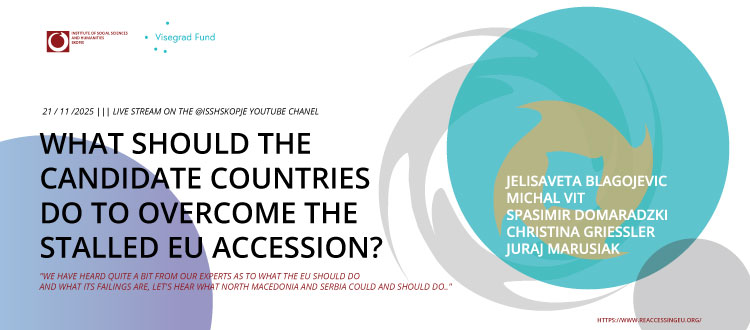
What should the candidate countries do to overcome the stalled EU accession?
It is our great honor to invite you to take part in the online panel titled “What should the candidate countries do to overcome the stalled EU accession?”. The panel will take place online on 21 November at 16:30, and you can watch it on the official YouTube channel of the Institute (https://www.youtube.com/@isshskopje ) and on the website of the project: https://www.reaccessingeu.org/podcasts
Panelists:
Jelisaveta Blagojević (Research Centre for Cultures, Politics and Identities – IPAK)
Michal Vit (Institute for Modern Development)
Spasimir Domaradzki (Institute of Central Europe)
Christina Griessler (Andrássy Gyula German-Speaking University Budapest)
Juraj Marušiak (Slovak Academy of Sciences: Institute of Political Science)
Moderator:
Risto Aleksovski (Institute of Social Sciences and Humanities – Skopje)
The online panel is part of the project “Combatting Anti-EU Discourses and Misinformation in North Macedonia and Serbia”, a 2025/2026 initiative implemented by an international consortium of European academic institutions and organizations (Andrássy Gyula German-Speaking University Budapest; Research Centre for Cultures, Politics and Identities – IPAK; Slovak Academy of Sciences: Institute of Political Science; Institute of Central Europe; and Institute for Modern Development), coordinated by the Institute of Social Sciences and Humanities – Skopje. The project is funded by the International Visegrad Fund.
About the project
Combatting Anti-EU Discourses and Misinformation in North Macedonia and Serbia
This project builds on a previous IVF-supported initiative titled “Alliances for EU.” One of the major takeaways from it was the need to address widespread misinformation about the EU negotiating framework and the rise of pro-Russian narratives portraying the EU as undemocratic.
The current project focuses on a relatively recent phenomenon: the virtual indistinguishability between pro-EU and anti-EU actors. In North Macedonia, traditional pro-EU civil society actors have increasingly shifted into the position of “disappointed Europeans,” consistently rejecting the negotiating framework-often referred to as the “French Proposal”- and interpreting it as an undemocratic, pro-Bulgarian trap set by the EU. Appeals to abandon EU accession have become overwhelming in public discourse, promoted by both the political left and right.
A similar dynamic marks Serbia: although actors differ on issues such as authoritarianism and overtly pro-Russian positions (notably those opposing Aleksandar Vučić), there is a broad consensus around disillusionment with the EU.
Thus, we are not dealing merely with simple misinformation or disinformation that can be resolved through factchecking alone, but rather with complex narrative-building processes by actors identified in a recent study commissioned by the German Bundestag (ISD, Mediaweb: December 2024). Addressing these narratives is essential for building a new social consensus.


About Post Author
